
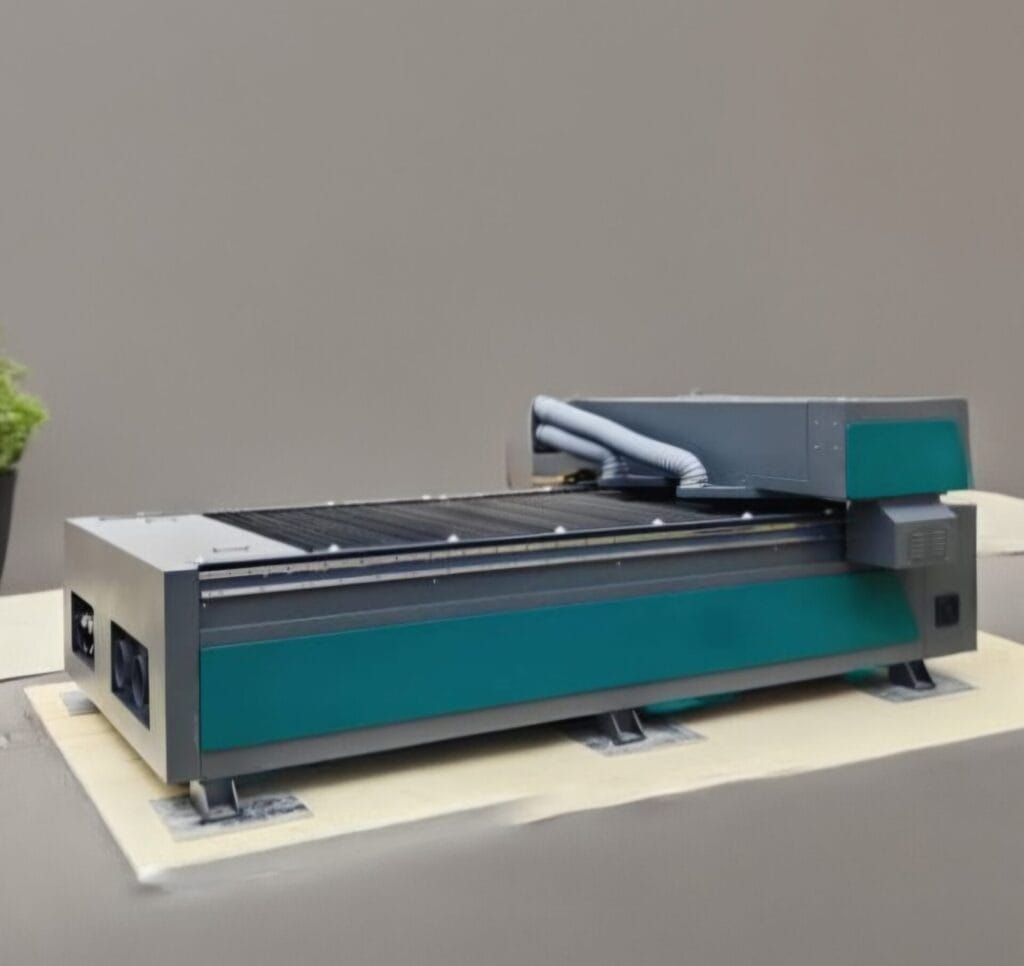
The question "CNC or laser for metal cutting" is perhaps the most common one we receive from Greek professionals. The answer depends on 5 factors: metal type, thickness, production volume, acceptable tolerances and budget. In this guide we objectively compare the three main technologies — CNC Router, Fiber Laser and CO₂ Laser — with cost, speed and cut quality data for each typical application. By the end you will know which technology is worth it for your case — no marketing, only real data from installations in the Greek market.
Quick comparison — which one for which purpose
| Material / application | Best choice | Alternative | No |
|---|---|---|---|
| Steel sheet ≤15mm | Fiber Laser | Plasma | CO₂, CNC Router |
| Stainless steel sheet ≤10mm | Fiber Laser | — | CO₂, CNC Router |
| Aluminum ≤8mm | Fiber Laser | CNC Router Hybrid | CO₂ |
| Aluminum 8–25mm | CNC Router Hybrid | Water-jet | Laser in general |
| Brass, copper | CNC Router Hybrid | Fiber (with mirrors) | CO₂ |
| Steel >15mm | Plasma / Oxy-fuel | Water-jet | All lasers/routers |
| 3D metal shaping (pocketing, relief) | CNC Router/Mill | — | All lasers |
Technology differences in plain terms
CNC Router — mechanical cutting
The CNC Router cuts with a rotating cutting tool (end mill) that wears down. Material is removed physically (chip removal). Main advantages: it can mill, pocket, and create 3D reliefs and curved surfaces — things a laser cannot do. It can cut very thick materials (aluminum up to 25mm, copper up to 15mm). Drawbacks: lower speed on thin flat cuts, need for cooling/lubrication on metals, tool wear (~€0,50–€3 per hour).
Fiber Laser — thermal metal cutting
The fiber laser emits a 1.064 nm wavelength beam that is absorbed extremely well by metals. It cuts 5–10× faster than a CNC Router on sheet metal, gives a clean edge with no mechanical contact and no cutting tools to replace. Ideal for flat 2D cuts. Drawback: flat cuts ONLY — no pockets, 3D reliefs or curved surfaces. Higher initial cost (€18K–€60K).
CO₂ Laser — mainly non-metals
The CO₂ laser cutter (10,6 µm) is not absorbed well by metals — it works superbly on wood, plexiglass, fabric and leather. It can cut thin stainless steel ≤1,5mm with oxygen assist gas, but slowly and at low quality. Not recommended for metal cutting as a primary application. Worth it if you cut 95% non-metals + occasional thin stainless steel. For complete selection guidance, see the CO₂ laser selection guide.
Performance comparison in specific applications
Application 1 — Cutting 5mm steel sheet (1000×500mm, complex design)
| Technology | Cutting time | Edge quality | Cost/part |
|---|---|---|---|
| Fiber Laser 3kW | ~4 minutes | Excellent, no post-processing | ~€1,80 |
| CNC Router Hybrid | ~45 minutes | Good, light grinding | ~€4.20 (+ tool wear) |
| Plasma CNC | ~6 minutes | Fair (thermal HAZ) | ~€2,20 |
| CO₂ Laser | Not viable | — | — |
Winner: Fiber Laser by a wide margin.
Application 2 — Milling a 20mm aluminum plate with internal pockets
| Technology | Capability | Comment |
|---|---|---|
| CNC Router Hybrid | YES | The only option for 3D geometry |
| Fiber Laser | NO | Through-cutting only, no pockets |
| CO₂ Laser | NO | Cannot even through-cut 20mm aluminum |
Winner: CNC Router — the only solution.
Application 3 — Mass production of cut 2mm stainless steel sheets (500 parts/day)
| Technology | Production rate | ROI with an 8-hour shift |
|---|---|---|
| Fiber Laser 2kW | ~60 parts/hour | Payback 14–18 months |
| CNC Router | ~8–10 pieces/hour | Not viable |
Winner: Fiber Laser — 6× productivity.
Application 4 — Drilling + cutting 10mm copper bus-bars
| Technology | Comment |
|---|---|
| CNC Router Hybrid | Preferred — cutting + drilling in a single setup |
| Fiber Laser | Requires special mirrors for copper (extra cost) |
| CO₂ Laser | Not viable |
Winner: CNC Router.
Initial investment cost (2026, excl. VAT)
| Technology | Entry | Semi-pro | Industrial |
|---|---|---|---|
| CO₂ Laser | €3.000 | €5.500–€8.000 | €12.000–€25.000 |
| CNC Router for metal | €2.800 | €10.000–€14.000 | €18.000–€45.000 |
| Fiber Laser | €18.000 | €28.000–€40.000 | €50.000–€100.000+ |
For detailed CNC Router prices per application, see the CNC Router for metal price guide.
Operating cost (€/hour — average)
| Category | CO₂ Laser | CNC Router | Fiber Laser |
|---|---|---|---|
| Electricity | €0,40–€1,00 | €0,30–€1,20 | €0,50–€2,00 |
| Consumables (lens / bits / nozzles) | €0,20 | €0,50–€3,00 | €0,15 |
| Assist gas | €0,30–€1,50 | €0 | €0,40–€2,00 |
| Maintenance (amortized) | €0,50 | €0,40 | €0,80 |
| Total €/hour | €1,40–€3,20 | €1,20–€4,60 | €1,85–€5,00 |
Note: the lower prices refer to entry-level machines, the higher ones to industrial machines.
Training time and user complexity
- CNC Router: harder for a beginner — requires knowledge of tooling, feed/speed, fixturing and CAM software. Typical mastering time: 40–80 hours of practice.
- Fiber Laser: relatively simple — the machine does the cutting; the operator selects material/thickness from the table and loads the DXF. Mastering: 8–15 hours.
- CO₂ Laser: simple to operate, fine-tuning of power/speed. Mastering: 10–20 hours.
How to decide — 4 decision questions
- What material do you mainly cut? Sheet metal → Fiber Laser. Bulk metal / 3D machining → CNC Router. Wood + plexiglass → CO₂ Laser (do not use it for metal).
- What is your production volume? <40 hours/month → outsourcing makes sense, not buying. 40–160 hours/month → semi-pro class. 160+ hours/month → industrial, with an upgrade option.
- What accuracy do you need? ±0,1mm → CNC Router or Fiber Laser. ±0,5mm → any of the technologies.
- What is your budget and available power supply? €5–€10K + single-phase → CO₂ or semi-pro CNC Router. €15K+ + three-phase → Fiber/Industrial options open up.
Hybrid solutions — when you need two machines
In industries producing metal parts with 2D cutting + 3D finishing, the Fiber Laser + CNC Router combination is the most productive. The fiber cuts the contours (seconds/part), the CNC router does the pocketing/threading/counterbores (minutes/part). Total throughput is 4–6× higher than either machine on its own.
ROI estimates (real customer cases)
- Furniture maker, Attica (CO₂ 130W, €7.500): payback in 11 months from outsourcing savings + new engraving orders.
- Sign-making workshop, Thessaloniki (CNC Router Hybrid 1300×2500, €19.500): payback in 14 months.
- Industrial plant, Boeotia (Fiber Laser 3kW, €45.000): payback in 10 months — replaced 600h/month of outsourcing.
Next steps
If you have settled on a technology, explore the corresponding categories:
- CNC Router machines — semi-pro to industrial
- Fiber laser for metal — steel/stainless/aluminum sheet
- CO₂ laser cutter — non-metals + engraving
If you want a second opinion, request a selection consultation — tell us your material, thicknesses, production volume and budget, and we reply within 24 hours with a technology + model recommendation.
Frequently asked questions (FAQ)
Which cuts aluminum better, a CNC Router or a Fiber Laser?
It depends on the thickness. For ≤8mm and flat cuts, the fiber laser is faster. For 8mm+ or 3D geometry (pockets, reliefs), the hybrid CNC Router is the only option.
Can I cut all metals with a fiber laser?
Most fiber lasers cut steel, stainless steel and aluminum. Copper and brass require special mirrors and high power (≥3kW) to be cut efficiently.
Is a CO₂ laser completely useless for metal?
Not completely, but it is limited. With oxygen assist gas and 130W+ you can cut stainless steel ≤1,5mm. For serious metal cutting, choose a fiber laser.
Which technology has the lowest maintenance?
The fiber laser — it has no cutting tools to replace and no tube to change (typical laser source lifespan: 100.000 hours). Main maintenance: cleaning the nozzle and protective window.
Can I start with a CNC Router and upgrade to Fiber later?
This is a common strategy. A CNC Router covers many applications (wood + light metal) on a low budget. When your sheet metal production grows, add a fiber laser without losing your investment — the two machines are complementary, not competing.
Not sure which technology to choose? Our team has installed hundreds of machines across Greece and knows when a CNC router is worth it and when a laser is. Request a selection consultation — free, with no obligation.
Sources & references
The following references support the technical specifications and reference prices in this guide:
- IPG Photonics — High-Power Fiber Lasers — industry-leading 2-15kW fiber laser sources with a 100.000h lifespan.
- Trumpf TruLaser Series — the industrial benchmark for fiber laser sheet metal cutting.
- Bystronic Laser Cutting — European leader in fiber + CO₂ laser cutting, technical comparisons.
- ISO 9013 — Thermal Cutting Standards — cut quality standard for laser, plasma and oxyfuel cutting.
- Shop Floor Lasers — Industry Magazine — industry publication with comparative CNC vs Laser reviews for metal fabrication.