
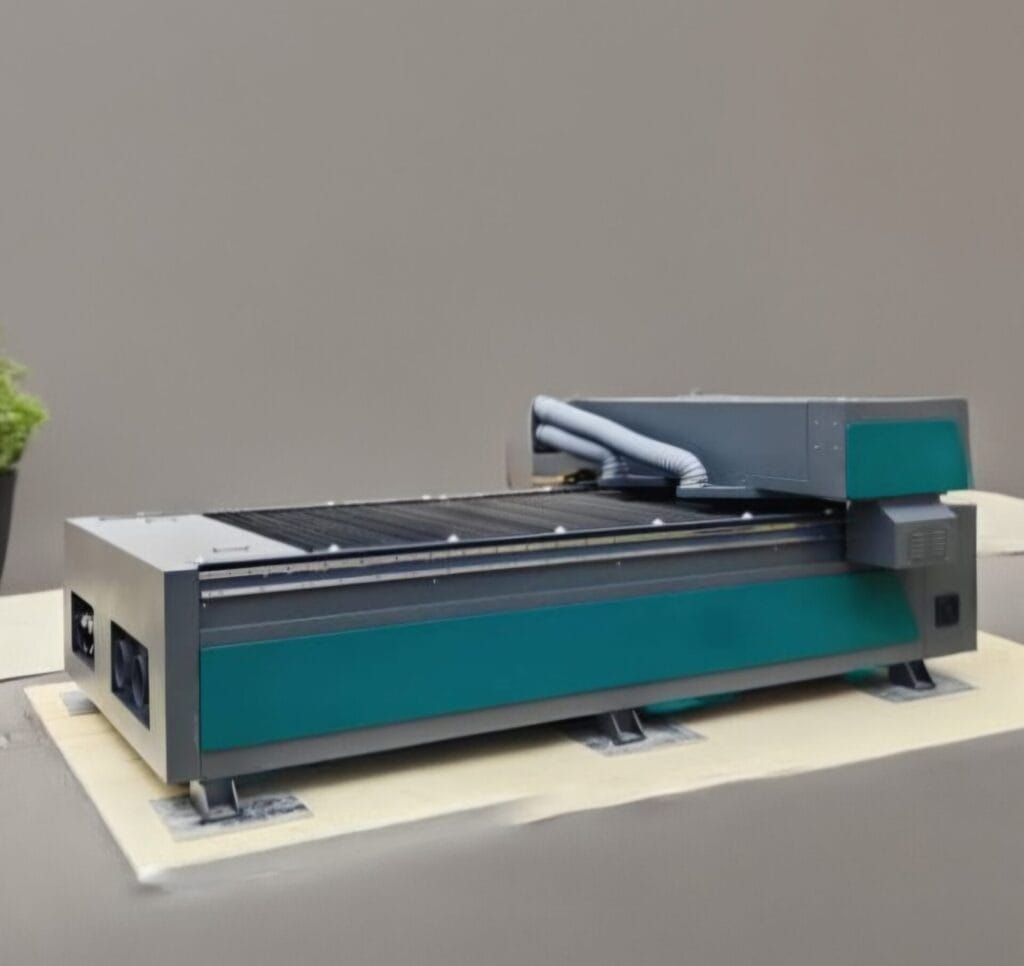
A CO₂ laser cutter can turn a small workshop or furniture business into a modern production unit — but only if you choose the right model. Buying a machine with the wrong power or wrong size often leads to production bottlenecks, premature tube wear and needless maintenance costs. In this guide we explain the 7 most important criteria to check before you buy, based on our ten years of experience installing and supporting CO₂ lasers in Greece. The goal: to make a decision based on facts, not marketing.
What a CO₂ Laser Cutter is and where it is used
A CO₂ laser cutter is a cutting and engraving machine that uses a carbon dioxide laser beam (10,6 µm wavelength). This wavelength is absorbed extremely well by non-metallic materials: wood, MDF, plywood, acrylic (plexiglass), leather, fabric, paper, rubber and thin stainless steel sheet (using assist gas). Typical users are furniture makers, sign shops, fashion studios, schools, maker spaces and packaging workshops.
In contrast to the fiber laser (ideal for metals) and the CNC router (mechanical cutting with a rotating tool), the CO₂ covers the widest range of non-metallic materials at a lower entry cost. For a full comparison, see our article CNC vs Laser: which technology for metal cutting.
7 criteria for choosing the right CO₂ Laser Cutter
1. Laser tube power (W)
- 60–80W: Ideal for engraving + cutting thin materials (wood ≤6mm, plexiglass ≤5mm). Suitable for schools, maker spaces and small workshops.
- 100–130W: The sweet spot for professional production — cutting 10–15mm wood, 10mm plexiglass, fast engraving. Recommended for 70% of professional applications.
- 150W+: Industrial cutting of thick materials and high-volume production. Higher initial cost but significantly shorter cutting time.
Mind the distinction between peak power vs nominal power — a 100W tube actually runs reliably at 80W in continuous operation.
2. Working area size (bed size)
The most common sizes: 900×600mm, 1300×900mm, 1600×1000mm, 1600×1300mm, 2000×1300mm. Choose based on the largest piece you will process regularly (not the most extreme one). A machine far larger than your needs costs more in floor space, electricity and laser tube.
3. Cooling system (chiller)
A CO₂ tube absolutely requires a closed-loop water chiller (CW-5000 or CW-5200 type). Professional machines include a chiller of the same brand; if not, add €400–€800 to your budget. Never use a simple water pump in a tank — the tube will be destroyed in less than 3 months.
4. Assist gas (air or oxygen)
For clean cuts without charring you need an air compressor (typically 60–80 L/min, 4–6 bar) or oxygen for metal cutting. Budget €200–€500 for a quality compressor.
5. Autofocus and lens cleaning
- Autofocus: saves 5–10 seconds per material change — in daily production this translates into hours.
- Fume filter / extraction: mandatory for operation indoors. Choose a model with at least HEPA H13.
6. Controller and software
- Ruida controller: the de-facto industrial standard, compatible with RDWorks V8 and LightBurn.
- LightBurn license: €60 one-time, worth every cent — the best software for CO₂ lasers.
- Avoid older LaserDRW controllers — limited community, fewer add-ons.
7. After-sales support
The most frequently underestimated criterion. The laser tube is replaced every 8.000–12.000 operating hours, lenses are cleaned/replaced, power supplies fail. Choose a Greek supplier with consumables in stock — a 4-week import from China means 4 weeks of lost production. CNC Laser Deals keeps tubes, lenses, mirrors and power supplies in stock for every model we sell.
Typical CO₂ Laser Cutter cost in Greece (2026)
| Category | Bed size | Power | Reference price (excl. VAT) |
|---|---|---|---|
| Introduction | 600×900mm | 80W | €3.000–€4.500 |
| Professional | 1300×900mm | 100W | €5.500–€8.000 |
| Production | 1600×1000mm | 130W | €8.500–€12.000 |
| Industrial | 1600×1300mm Auto-Feed | 150W+ | €15.000–€25.000 |
The prices above include chiller, exhaust, basic compressor and installation. For our complete current range of laser cutter machines, see our category or request a quote with your exact requirements.
Common buying mistakes (don't make them)
- Buying a "cheap" eBay-grade machine with no local support — every €1.500 saved translates into €3.000+ of lost production when it breaks down.
- Underestimating the power supply at installation — professional models need a stabilized supply and often a UPS for the chiller.
- Ignoring fire safety — a CO₂ laser cuts flammable materials; install an automatic fire extinguisher in the cutting chamber (~€150).
- Learning by "trial and error" — a good 2-hour training session saves weeks of wrong settings.
Next steps
If you have a clear picture of your needs, browse our collection of laser cutter machines or contact us for a tailored quote — we will reply within 24 hours with a proposal suited to your production volume, available space and budget.
Frequently asked questions (FAQ)
Can a CO₂ laser cut metal?
Only thin metals (up to 1,5–2mm stainless steel with oxygen assist gas), and not efficiently. For cutting metal over 2mm, choose a fiber laser.
How long does a CO₂ tube last?
8.000–12.000 operating hours for tubes from brand-name manufacturers (Reci, Yongli, EFR). At 6 hours of daily use, that is roughly 5–8 years.
Do I need a special license to operate a CO₂ laser?
No license, but you must comply with Class 4 laser safety regulations (enclosed chamber, door interlocks, warning signs).
Which software should I use?
LightBurn (€60 one-time) is the standard professional choice. RDWorks V8 (free with Ruida controllers) works but is less friendly for new users.
Do you provide installation and training?
Yes, throughout Greece. Installation and 2-hour operator training are included with all professional models (>€5.500).
Looking for the right CO₂ laser cutter for your production? The CNC Laser Deals team can help. Request a free quote — we reply within 24 hours with a tailored proposal, ROI analysis and installation schedule.
Sources & references
The following references support the technical specifications and reference prices in this guide:
- Reci Laser — CO₂ Tube Specs — leading manufacturer with a documented 10.000+ hour lifespan for 100W-180W tubes.
- LightBurn — CO₂ Laser Software — €60 one-time license, supports Ruida/TopWisdom controllers.
- Ruida Technology — Controllers — the de-facto industrial controller standard for professional CO₂ laser cutters.
- ISO 60825-1 Laser Safety Standards — the industrial safety standard for Class 4 lasers — mandatory for professional use.
- OSHA Laser Hazards Guide — guidelines for the safe operation of CO₂ laser cutters in the workplace.